Sunday, February 25, 2018
Ahead Of The Pack: What Sets Energy Innovators Apart?
Bottom line: Some diligent companies have already added renewables to their portfolios and will stand out as the clear winners, while the others struggle to reconcile with reality.
A number of oil-producing countries are formulating strategies to diversify their highly oil-dependent economies away from oil. Even power companies like General Electric and Siemens are realizing renewables’ future and formulating strategies accordingly.
When attempting to shape future predictions, start with brainstorming sessions in which you analyze the present, and how the changing dynamic of the aforementioned factors might affect your future businesses. Identify challenges and think about how to convert them into opportunities.
What appears to be nonsense today often turns out to be tomorrow’s reality.
By Dr. Salman Ghouri for Oilprice.com

How Will Fossil Fuels Fare In 2040?
By Salman Ghouri - Dec 23, 2017, 12:00 PM CST
Fossil fuels have been the dominant source of energy for global economic prosperity for over 150 years.
In 2016, fossil fuels overwhelmingly account for over 85 percent in global total primary energy consumption (TPEC)—but what role will they play in 2040 and beyond? There’s an ongoing debate among various agencies, researchers and academia whether the role of fossil fuels will significantly diminish.
The innovation in fuel cells, electric vehicles and the significant decline in cost of solar and wind power are fossil fuels’ greatest challenges. How much of fossil fuels’ share will be taken by renewable sources by 2040, and is it substantial enough to undermine the role of oil and gas industry, or is there no need to worry?
The oil industry is transforming due to the auto industry’s structural shift from internal combustion engine (ICEs) to electric vehicles (EVs), reducing global demand. But this will create additional electricity demand. In 2016, out of the global total population of 7.3 billion, more than 1.5 billion (20 percent) people are without electricity, and over billions only for a few hours. In order to meet the power demand of global population, the industry will need trillions of dollars in power generation, transmission and distribution system. Naturally, trillion-dollar investment is required here.
History shows us that countries with higher per-capita energy consumption experience stronger economic growth. This relationship is even stronger with electricity consumption. So for global economic prosperity, power is the prerequisite for takeoff. Coal still remains the dominant source of electricity generation. However, under the umbrella of the Paris Accord, all countries—particularly the major coal-consuming countries for power generation, like China and India—plan to shift toward clean energy.
As such, general perception is that natural gas gets a free ride since it’s replacing coal. However, the speedy developments of renewables, particularly wind and solar, seems to dash this perception. During this learning-curve journey, global wind and solar energy capacities respectively increased from 59 GW and 5.6 GW in 2005 to 486 GW and 306 GW in 2016, backed by a substantial decline in prices (Figure-1 & 2).
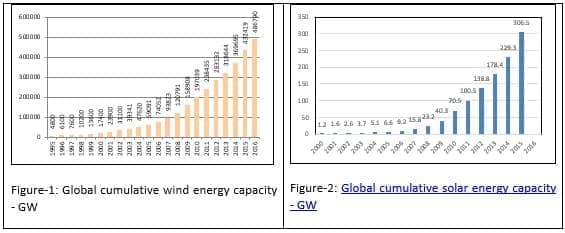
(Click to enlarge)
Natural gas resources are located far from the major consumption centers—43 percent alone in the Middle East, and Africa at 7.6 percent. In contrast, consuming countries are located in developed areas, and now the thrust is shifting to Asia. The Asian region, where 60 percent of world population resides, has the capacity to consume the bulk of natural gas; however, it’s constrained by its availability, infrastructure and transport expense. In 2016, out of 3543 bcm total global natural gas consumption, 69 percent was locally consumed, 31 percent traded as pipeline (737 bcm) gas and LNG (347 bcm). Furthermore, the natural gas spot market is in its infancy, therefore the bulk of gas is sold under long-term contracts.
In contrast to natural gas reserves, almost all the countries are endowed with enormous sun and wind resources. Renewables nurtured on the laps of government subsidies have matured, and prices have significantly declined (Figure-3). For example, take the recent announcement of record-low auction prices as low as three cents per kilowatt-hour, including India, the United Arab Emirates, Mexico and Chile. Global average generation costs are estimated to further decline for 2017-2022. We also recently learned that auction prices indicate much steeper possible cost reductions, ranging from $30-45/MWh for solar PV (India, Mexico, United Arab Emirates, Argentina) to $35-50/MWh for onshore wind (India, Morocco, Egypt, Turkey, Chile). Therefore, natural gas should no longer expect to get a free ride as it gears up to substitute coal. Instead, it should brace for stiff challenges from renewables.

Despite challenges and constraints, the role of natural gas in TPEC is up from 24 percent (2016) to 30 percent (2040), but the biggest gainer will likely be a renewable that’s likely to go up from 3 percent in 2016 to around 12 percent to 15 percent in 2040.
One can argue the 12 percent or 15 percent numbers, but it’s certain that the penetration of renewables in power generation undermines other sources of energies.
An advantage of renewables is that there’s not necessarily a huge upfront capital investment in the transmission system. Solar panels and wind farms can provide electricity to the community without big investments in their transmission systems, especially when populations are scattered in developing countries, thus overcoming the hurdle of transmission cost/constraint.
Oil’s share will be hit hard, and could shrink from 33 percent in 2016 to around 25 percent in 2040 due to EVs and increasing ICE efficiency. Coal, once the dominant source in power generation, could decline from 28 percent in 2016 to 20 percent in 2040. Regardless, many countries with abundant coal resources and limited alternative sources will carry on as usual.
Availability and competitive prices are important. For example, in the United States, due to the shale gas boom’s big difference, power generation from coal down dropped from 53 percent in 2007 to around 30 percent in 2016. As such, the role of fossil fuels is expected to drop from 85.6 percent in 2016 to around 75 percent in 2040. The role of hydro and nuclear should remain at their current level of about 7 percent and 6 percent in 2040.
For natural gas to gain strong footing and capture market share of 30 percent in TPEC requires a lot of innovation and outside-the-box strategy. Rather than selling big LNG quantities, they should consider smaller quantities (like selling to grocery stores rather than wholesale markets). In order to achieve this strategy, they need to look back at history—rather than looking for big trains like 7.8 MTPA and larger, companies should look for smaller size trains, LNG carriers, and even FSRUs to meet the demand of a large number of smaller customers.
Along with power and industrial sectors, the natural gas industry should focus on marine fuel (particularly the shipping industry) and look for markets in Africa, Central America, and South America rather than focusing only on traditional Asian markets.
It’s time to create demand for natural gas where resources are located rather than only looking at the capital-intensive export options. A sizable natural gas reserve (7.6 percent) is located in Africa. Over 16 percent of the global population resides there, with most generally deprived of power—still struggling to take off. The regional per capita energy consumption is around 15 million btu, compared to Asia’s 50, with developed regions close to 200.
There’s much potential in Africa, Central America, and South America. It will require a strategy to create opportunities via investments in integrated projects in these areas with rich resources and poor economies, which could then generate increased regional economic activity. At last, these countries could finally utilize their indigenous energy resources.
By Dr. Salman Ghouri
More Top Reads From Oilprice.com:
Fossil fuels have been the dominant source of energy for global economic prosperity for over 150 years.
In 2016, fossil fuels overwhelmingly account for over 85 percent in global total primary energy consumption (TPEC)—but what role will they play in 2040 and beyond? There’s an ongoing debate among various agencies, researchers and academia whether the role of fossil fuels will significantly diminish.
The innovation in fuel cells, electric vehicles and the significant decline in cost of solar and wind power are fossil fuels’ greatest challenges. How much of fossil fuels’ share will be taken by renewable sources by 2040, and is it substantial enough to undermine the role of oil and gas industry, or is there no need to worry?
The oil industry is transforming due to the auto industry’s structural shift from internal combustion engine (ICEs) to electric vehicles (EVs), reducing global demand. But this will create additional electricity demand. In 2016, out of the global total population of 7.3 billion, more than 1.5 billion (20 percent) people are without electricity, and over billions only for a few hours. In order to meet the power demand of global population, the industry will need trillions of dollars in power generation, transmission and distribution system. Naturally, trillion-dollar investment is required here.
History shows us that countries with higher per-capita energy consumption experience stronger economic growth. This relationship is even stronger with electricity consumption. So for global economic prosperity, power is the prerequisite for takeoff. Coal still remains the dominant source of electricity generation. However, under the umbrella of the Paris Accord, all countries—particularly the major coal-consuming countries for power generation, like China and India—plan to shift toward clean energy.
As such, general perception is that natural gas gets a free ride since it’s replacing coal. However, the speedy developments of renewables, particularly wind and solar, seems to dash this perception. During this learning-curve journey, global wind and solar energy capacities respectively increased from 59 GW and 5.6 GW in 2005 to 486 GW and 306 GW in 2016, backed by a substantial decline in prices (Figure-1 & 2).
(Click to enlarge)
Natural gas resources are located far from the major consumption centers—43 percent alone in the Middle East, and Africa at 7.6 percent. In contrast, consuming countries are located in developed areas, and now the thrust is shifting to Asia. The Asian region, where 60 percent of world population resides, has the capacity to consume the bulk of natural gas; however, it’s constrained by its availability, infrastructure and transport expense. In 2016, out of 3543 bcm total global natural gas consumption, 69 percent was locally consumed, 31 percent traded as pipeline (737 bcm) gas and LNG (347 bcm). Furthermore, the natural gas spot market is in its infancy, therefore the bulk of gas is sold under long-term contracts.
In contrast to natural gas reserves, almost all the countries are endowed with enormous sun and wind resources. Renewables nurtured on the laps of government subsidies have matured, and prices have significantly declined (Figure-3). For example, take the recent announcement of record-low auction prices as low as three cents per kilowatt-hour, including India, the United Arab Emirates, Mexico and Chile. Global average generation costs are estimated to further decline for 2017-2022. We also recently learned that auction prices indicate much steeper possible cost reductions, ranging from $30-45/MWh for solar PV (India, Mexico, United Arab Emirates, Argentina) to $35-50/MWh for onshore wind (India, Morocco, Egypt, Turkey, Chile). Therefore, natural gas should no longer expect to get a free ride as it gears up to substitute coal. Instead, it should brace for stiff challenges from renewables.
Despite challenges and constraints, the role of natural gas in TPEC is up from 24 percent (2016) to 30 percent (2040), but the biggest gainer will likely be a renewable that’s likely to go up from 3 percent in 2016 to around 12 percent to 15 percent in 2040.
One can argue the 12 percent or 15 percent numbers, but it’s certain that the penetration of renewables in power generation undermines other sources of energies.
An advantage of renewables is that there’s not necessarily a huge upfront capital investment in the transmission system. Solar panels and wind farms can provide electricity to the community without big investments in their transmission systems, especially when populations are scattered in developing countries, thus overcoming the hurdle of transmission cost/constraint.
Oil’s share will be hit hard, and could shrink from 33 percent in 2016 to around 25 percent in 2040 due to EVs and increasing ICE efficiency. Coal, once the dominant source in power generation, could decline from 28 percent in 2016 to 20 percent in 2040. Regardless, many countries with abundant coal resources and limited alternative sources will carry on as usual.
Availability and competitive prices are important. For example, in the United States, due to the shale gas boom’s big difference, power generation from coal down dropped from 53 percent in 2007 to around 30 percent in 2016. As such, the role of fossil fuels is expected to drop from 85.6 percent in 2016 to around 75 percent in 2040. The role of hydro and nuclear should remain at their current level of about 7 percent and 6 percent in 2040.
For natural gas to gain strong footing and capture market share of 30 percent in TPEC requires a lot of innovation and outside-the-box strategy. Rather than selling big LNG quantities, they should consider smaller quantities (like selling to grocery stores rather than wholesale markets). In order to achieve this strategy, they need to look back at history—rather than looking for big trains like 7.8 MTPA and larger, companies should look for smaller size trains, LNG carriers, and even FSRUs to meet the demand of a large number of smaller customers.
Along with power and industrial sectors, the natural gas industry should focus on marine fuel (particularly the shipping industry) and look for markets in Africa, Central America, and South America rather than focusing only on traditional Asian markets.
It’s time to create demand for natural gas where resources are located rather than only looking at the capital-intensive export options. A sizable natural gas reserve (7.6 percent) is located in Africa. Over 16 percent of the global population resides there, with most generally deprived of power—still struggling to take off. The regional per capita energy consumption is around 15 million btu, compared to Asia’s 50, with developed regions close to 200.
There’s much potential in Africa, Central America, and South America. It will require a strategy to create opportunities via investments in integrated projects in these areas with rich resources and poor economies, which could then generate increased regional economic activity. At last, these countries could finally utilize their indigenous energy resources.
By Dr. Salman Ghouri
More Top Reads From Oilprice.com:
Two Undeniable Shifts In Today’s Energy Markets
By Salman Ghouri - Oct 25, 2017, 4:00 PM CDT
A couple of huge structural shifts are coming for the energy sector over the next few decades, thanks to the growth of certain technological and environmental challenges.
The first challenge comes from electricity generation, which impacts the demand for coal and natural gas. The second challenge is from transportation changes, as the shift away from the internal combustion engine to the electric drivetrain will hit oil demand, particularly from the transportation sector.
Without question, electricity is by far the most important source of energy for global economic growth and human prosperity There’s a strong positive correlation between electricity consumption and economic growth, regardless of whether it’s generated by coal, oil, natural gas, hydro, nuclear or renewables, the end result is power generation that’s critical for the progress of humanity. Electricity is needed to run our industries, commercial usage, lighting, cooking, heating and cooling and even required for the transport sector. Life pauses when there’s an electricity outage—a disruption in communication systems makes us feel helpless.
Demand for electricity is expected to grow strongly due to the rapid global economic and population growth. Right now, over a billion people don’t have access to electricity, and billions of those who do have access only have it for a few hours a day. As economies of emerging and developing countries are poised for growth, demand for electricity is expected to grow strongly. Furthermore, additional demand for electricity is expected to result from a structural shift in the transportation sector.
Historically, coal has been the major source of electricity generation, and in 2015 accounted for about 40 percent of total power generation (large emerging economies such as China and India use more coal, 72 percent and over 65 percent of their total power generation mix, respectively). However, due to environmental challenges and the Paris Climate accord, the way we generate electricity is set to change.
Related: This Oil Rally May Be Short-Lived
According to the EIA-IEO-2017, renewables (including hydropower) are and will be the fastest-growing sources of electricity generation from 2015 to 2040. Total renewables are projected to grow at an annualized average rate of 2.8 percent per year, while natural gas generation is poised to grow by an average of 2.1 percent per year from 2015 to 2040, and nuclear generation is set to grow by 1.5 percent per year.
The biggest game changer is perhaps the penetration of renewable in electricity generation substituting coal. Hydropower’s share in renewable generation, however, is expected to fall from 71 percent in 2015 to 53 percent in 2040 due to environmental concerns limiting the development of a number of new mid- and large-scale hydropower projects. Therefore, major growth is expected to come from wind, solar and natural gas. Incidentally, coal’s generation share is expected to decline from 40 percent in 2015 to 31 percent (or even well below 30 percent) by 2040, and renewables share is expected to rise from about 19 percent (including hydropower) in 2015 to 31 percent or even more in 2040, when fusion energy becomes a commercial option.
Oil is currently the single most important source of energy being used in transportation sector—road, air, rail and sea. Since the invention of internal combustion engines (ICEs) in the early 1900s, oil demand has been on the rise. By the end of 2016, over 96 million bpd of oil were consumed, of which over 64 percent has been associated with transportation sector.
Due to increased efficiency in ICEs, and the rapid rise in EVs, autonomous vehicles, hybrid-cars, CNG and fuel cell vehicles, oil demand should decrease in years to come. As such, global oil demand will peak and then taper off. By 2040, oil demand is could range between 70 and 80 mmbd (instead of reaching 121 mmbd as predicted by the EIA and other agencies). The main reason for this demand drop includes significant improvement in miles driven per gallon, and of course, the rise of EV’s. Just a few years ago, mass-appeal electric transport seemed a distant reality, but today, no one can ignore this mammoth change happening in the auto industry, especially when more than 64 percent of oil demand is associated with transportation.
Over time, global electricity demand will increase significantly, and most new generation will come from renewables and natural gas. Coal’s role is expected to shrink to below 31 percent from the current level of around 40 percent. Technological advancements have pushed down break-even costs and many projects are now viable without government subsidies. Next to renewables, the role of natural gas in power generation is poised to grow significantly. All these efforts will help in achieving Paris climate accord targets.
The shale gas boom has allowed the United States to curb the use of coal in power generation. Coal’s share in U.S. power generation fell from 48 percent in 2007 to about 30 percent in 2016. The natural gas contribution, however, went up from 22 percent in 2007 to 33.8 percent in 2016, thanks to the commodity’s falling price. If such a shale gas boom could be replicated in China and India, coal’s place could fall well below 30 percent in 2040 and help in mitigating the impact of energy usage on the environment.
While these major shifts could make the world more prosperous and environmental friendly, the trends could have a detrimental impact on countries that rely heavily upon oil revenues.
By Salman Ghouri for Oilprice.com
A couple of huge structural shifts are coming for the energy sector over the next few decades, thanks to the growth of certain technological and environmental challenges.
The first challenge comes from electricity generation, which impacts the demand for coal and natural gas. The second challenge is from transportation changes, as the shift away from the internal combustion engine to the electric drivetrain will hit oil demand, particularly from the transportation sector.
Without question, electricity is by far the most important source of energy for global economic growth and human prosperity There’s a strong positive correlation between electricity consumption and economic growth, regardless of whether it’s generated by coal, oil, natural gas, hydro, nuclear or renewables, the end result is power generation that’s critical for the progress of humanity. Electricity is needed to run our industries, commercial usage, lighting, cooking, heating and cooling and even required for the transport sector. Life pauses when there’s an electricity outage—a disruption in communication systems makes us feel helpless.
Demand for electricity is expected to grow strongly due to the rapid global economic and population growth. Right now, over a billion people don’t have access to electricity, and billions of those who do have access only have it for a few hours a day. As economies of emerging and developing countries are poised for growth, demand for electricity is expected to grow strongly. Furthermore, additional demand for electricity is expected to result from a structural shift in the transportation sector.
Historically, coal has been the major source of electricity generation, and in 2015 accounted for about 40 percent of total power generation (large emerging economies such as China and India use more coal, 72 percent and over 65 percent of their total power generation mix, respectively). However, due to environmental challenges and the Paris Climate accord, the way we generate electricity is set to change.
Related: This Oil Rally May Be Short-Lived
According to the EIA-IEO-2017, renewables (including hydropower) are and will be the fastest-growing sources of electricity generation from 2015 to 2040. Total renewables are projected to grow at an annualized average rate of 2.8 percent per year, while natural gas generation is poised to grow by an average of 2.1 percent per year from 2015 to 2040, and nuclear generation is set to grow by 1.5 percent per year.
The biggest game changer is perhaps the penetration of renewable in electricity generation substituting coal. Hydropower’s share in renewable generation, however, is expected to fall from 71 percent in 2015 to 53 percent in 2040 due to environmental concerns limiting the development of a number of new mid- and large-scale hydropower projects. Therefore, major growth is expected to come from wind, solar and natural gas. Incidentally, coal’s generation share is expected to decline from 40 percent in 2015 to 31 percent (or even well below 30 percent) by 2040, and renewables share is expected to rise from about 19 percent (including hydropower) in 2015 to 31 percent or even more in 2040, when fusion energy becomes a commercial option.
Oil is currently the single most important source of energy being used in transportation sector—road, air, rail and sea. Since the invention of internal combustion engines (ICEs) in the early 1900s, oil demand has been on the rise. By the end of 2016, over 96 million bpd of oil were consumed, of which over 64 percent has been associated with transportation sector.
Due to increased efficiency in ICEs, and the rapid rise in EVs, autonomous vehicles, hybrid-cars, CNG and fuel cell vehicles, oil demand should decrease in years to come. As such, global oil demand will peak and then taper off. By 2040, oil demand is could range between 70 and 80 mmbd (instead of reaching 121 mmbd as predicted by the EIA and other agencies). The main reason for this demand drop includes significant improvement in miles driven per gallon, and of course, the rise of EV’s. Just a few years ago, mass-appeal electric transport seemed a distant reality, but today, no one can ignore this mammoth change happening in the auto industry, especially when more than 64 percent of oil demand is associated with transportation.
Over time, global electricity demand will increase significantly, and most new generation will come from renewables and natural gas. Coal’s role is expected to shrink to below 31 percent from the current level of around 40 percent. Technological advancements have pushed down break-even costs and many projects are now viable without government subsidies. Next to renewables, the role of natural gas in power generation is poised to grow significantly. All these efforts will help in achieving Paris climate accord targets.
The shale gas boom has allowed the United States to curb the use of coal in power generation. Coal’s share in U.S. power generation fell from 48 percent in 2007 to about 30 percent in 2016. The natural gas contribution, however, went up from 22 percent in 2007 to 33.8 percent in 2016, thanks to the commodity’s falling price. If such a shale gas boom could be replicated in China and India, coal’s place could fall well below 30 percent in 2040 and help in mitigating the impact of energy usage on the environment.
While these major shifts could make the world more prosperous and environmental friendly, the trends could have a detrimental impact on countries that rely heavily upon oil revenues.
By Salman Ghouri for Oilprice.com
The Single Most Important KPI For Oil & Gas Companies
It is no secret that the CEOs, owners, shareholders and creditors are curious to know how a company is progressing. If there was only one KPI that could measure the overall performance of a multinational Oil & Gas company, which one would those with a stake in the company choose?
In every organization, there are a number of Key Performance Indicators (KPIs) which help to assess its financial health, physical performance, operational excellence and health, safety and environment (HSE).
It is often seen that management develops a series of KPIs for each category and displays it on the management dashboard to assess the health of the organization. The objective of such KPIs is to facilitate appropriate and timely decisions in order to steer the company towards its set objectives. For each category, there could be many KPIs, all of which may be of equal importance. However, if the shareholder or CEO or creditors are interested in one single KPI, which one should be given greater emphasis and why?
Any layman can suggest the main objective of any oil and gas company is to maximize profit while increasing the value of the company year after year. In order to do this, the company must generate more revenue while cutting costs. To achieve this, the company must enhance its oil and gas production year after year. For the sake of discussion, we are assuming that oil prices are to hover around $50/bbls for many years. This would suggest that revenue and profitability hinges on the level of production, while remaining vigilant on cost.
This is to say that a company needs to continually invest its financial resources in exploration and development activities to broaden their portfolio. The greater the proved oil and gas reserves added to the company’s resource base, the greater the value of the company.
Maximizing profit increases the value for shareholders, but oil and gas companies must continue to produce more in succeeding years. The problem with this, however, is that production of oil and gas resources today, means that a barrel of oil produced today will not be a part of the portfolio tomorrow. That is, with the production of each barrel of oil, remaining proved reserves will deplete unless new reserves are added to replenish the quantity produced. This is what is called the Reserves Replacement Ratio, and it is one of the KPIs CEOs and shareholders would be interested in measuring to assess the overall performance of the organization.
If the company were to fail to discover and add new proved reserves, its available resources would eventually be exhausted, leaving the company in a rather difficult position.
This ratio is especially important as it provides a glimpse into the overall health of the company, including how well the company’s upstream operations are performing – are they acquiring enough blocks, acreage, drilling exploratory wells and making enough discoveries? Failure to achieve this single KPI means the company is unable to increase oil and gas production year after year, reflecting negatively in the financial performance of the company’s profit & loss statement.
By Salman Ghouri for Oilprice.com
In every organization, there are a number of Key Performance Indicators (KPIs) which help to assess its financial health, physical performance, operational excellence and health, safety and environment (HSE).
It is often seen that management develops a series of KPIs for each category and displays it on the management dashboard to assess the health of the organization. The objective of such KPIs is to facilitate appropriate and timely decisions in order to steer the company towards its set objectives. For each category, there could be many KPIs, all of which may be of equal importance. However, if the shareholder or CEO or creditors are interested in one single KPI, which one should be given greater emphasis and why?
Any layman can suggest the main objective of any oil and gas company is to maximize profit while increasing the value of the company year after year. In order to do this, the company must generate more revenue while cutting costs. To achieve this, the company must enhance its oil and gas production year after year. For the sake of discussion, we are assuming that oil prices are to hover around $50/bbls for many years. This would suggest that revenue and profitability hinges on the level of production, while remaining vigilant on cost.
This is to say that a company needs to continually invest its financial resources in exploration and development activities to broaden their portfolio. The greater the proved oil and gas reserves added to the company’s resource base, the greater the value of the company.
Maximizing profit increases the value for shareholders, but oil and gas companies must continue to produce more in succeeding years. The problem with this, however, is that production of oil and gas resources today, means that a barrel of oil produced today will not be a part of the portfolio tomorrow. That is, with the production of each barrel of oil, remaining proved reserves will deplete unless new reserves are added to replenish the quantity produced. This is what is called the Reserves Replacement Ratio, and it is one of the KPIs CEOs and shareholders would be interested in measuring to assess the overall performance of the organization.
If the company were to fail to discover and add new proved reserves, its available resources would eventually be exhausted, leaving the company in a rather difficult position.
This ratio is especially important as it provides a glimpse into the overall health of the company, including how well the company’s upstream operations are performing – are they acquiring enough blocks, acreage, drilling exploratory wells and making enough discoveries? Failure to achieve this single KPI means the company is unable to increase oil and gas production year after year, reflecting negatively in the financial performance of the company’s profit & loss statement.
By Salman Ghouri for Oilprice.com
What Does OPEC Do Next?
Time is of the essence. If you fail to comprehend future market conditions and fail to steer the ship in the right direction, it can lead to disaster. This is what we have learned during the past few years. OPEC’s failure to understand the future market conditions and speed of technological advancements has resulted in economic setbacks.
A 2012 paper about the role of U.S. shale oil in global oil markets suggested that “It could be in the interest of OPEC to already increase its production now and allow oil prices to decline to below $60 to discourage further development of shale oil”. The industry, and more particularly OPEC, continued with their “business as usual” strategy, unaware of the dramatic impact U.S. shale would have on oil prices.
$100+ oil prices allowed companies to master the fracturing technology. As a result, the shale industry was able to increase average productivity per well by employing advanced horizontal drilling techniques, multi-stage fracturing and concentrating towards the most productive areas of the basin. For example, oil productivity per rig for the Bakken increased from 112 b/d in January 2007 to 746 b/d in March 2016 – over 6.6 fold increase. Improvements were also made in terms of Estimated Ultimate Recovery (EURs) which in some of the basins reached 50 to 60 percent in 2015/16.
The higher U.S. shale oil production started to take its toll on oil prices in the second half of 2014. To counter the new enemy (shale oil), OPEC, contrary to its traditional tool of curbing its own production, flooded the market for an extended period of time, explaining that it was merely defending its own market share and assuming that such policy would incur permanent damage to the U.S. shale industry.
Having executed this strategy for over 2 years, OPEC realized that the continuation of such a policy was quite detrimental to the economies of its members. Most OPEC members had to take some unpopular decisions to curb government expenses, including downsizing, drastic cost cutting measures, removing subsidies and cancelling megaprojects. All these efforts provided them with some breathing space and also avoided complete economic collapse.
Eventually, OPEC reverted back to their old wisdom of cutting oil production, which saw oil prices creep up to the mid-fifties. The oil bust taught them a good lesson and made them realize how dependent their economies are on oil revenues. A good example of this is the Saudi Vision 2030 diversification plan, which is aimed at reducing reliance on oil income.
Oil prices around $50 might provide some relief for OPEC countries, U.S. shale producers directly responded and the number of drilling rigs substantially increased in the last couple of months. And now the U.S. shale patch has brought break-even costs per barrel down even further, Shale oil production could even increase as oil prices fall below $50 per barrel again.
Offering some clues on how the cartel could defend its market share, an article by the author, published last year on Oilprice.com forecasts the responsiveness of U.S. shale oil production against various oil price scenarios.
In the base scenario, if oil prices gradually increase to $78/bbl, than by December 2020, total U.S. shale oil production from the given seven basins would increase to 6.79 MMBPD – an increase of 37 percent compared to March 2016. In contrast, under low oil price scenarios (range of mid thirties and mid twenties), shale oil production would decline in all the basins and by December 2020 would fall to 3.03 MMBPD, a decline of 67 percent compared to March 2016.
The hard lesson learned during the past few years is that due to technological advancements, U.S. shale oil producers can lower their breakeven prices and challenge OPEC’s market dominance.
One strategy, if OPEC aims to harm U.S. shale oil producers, is to stop intervening in oil markets, provoking a drastic fall in oil prices – possibly back to $30 per barrel. Such a drop in crude prices could crash shale oil production in almost all the seven U.S. basins. By the end of 2020, their cumulative production could fall down to 3.03 mmbpd. This could potentially evaporate excess global supply, however, this strategy will once again have a devastating impact on the economies of individual OPEC members. As such, OPEC are unlikely to initiate such a self-defeating strategy.
Higher oil prices of over $60/bbl on the other hand, will allow most of the seven shale oil producers to increase production, keeping oil prices in a narrow range. In such a scenario, oil prices within the range of $50 to $60/bbls will balance the global demand/supply and will not be detrimental to either producers or consumers.

By Salman Ghouri for Oilprice.com
A 2012 paper about the role of U.S. shale oil in global oil markets suggested that “It could be in the interest of OPEC to already increase its production now and allow oil prices to decline to below $60 to discourage further development of shale oil”. The industry, and more particularly OPEC, continued with their “business as usual” strategy, unaware of the dramatic impact U.S. shale would have on oil prices.
$100+ oil prices allowed companies to master the fracturing technology. As a result, the shale industry was able to increase average productivity per well by employing advanced horizontal drilling techniques, multi-stage fracturing and concentrating towards the most productive areas of the basin. For example, oil productivity per rig for the Bakken increased from 112 b/d in January 2007 to 746 b/d in March 2016 – over 6.6 fold increase. Improvements were also made in terms of Estimated Ultimate Recovery (EURs) which in some of the basins reached 50 to 60 percent in 2015/16.
The higher U.S. shale oil production started to take its toll on oil prices in the second half of 2014. To counter the new enemy (shale oil), OPEC, contrary to its traditional tool of curbing its own production, flooded the market for an extended period of time, explaining that it was merely defending its own market share and assuming that such policy would incur permanent damage to the U.S. shale industry.
Having executed this strategy for over 2 years, OPEC realized that the continuation of such a policy was quite detrimental to the economies of its members. Most OPEC members had to take some unpopular decisions to curb government expenses, including downsizing, drastic cost cutting measures, removing subsidies and cancelling megaprojects. All these efforts provided them with some breathing space and also avoided complete economic collapse.
Eventually, OPEC reverted back to their old wisdom of cutting oil production, which saw oil prices creep up to the mid-fifties. The oil bust taught them a good lesson and made them realize how dependent their economies are on oil revenues. A good example of this is the Saudi Vision 2030 diversification plan, which is aimed at reducing reliance on oil income.
Oil prices around $50 might provide some relief for OPEC countries, U.S. shale producers directly responded and the number of drilling rigs substantially increased in the last couple of months. And now the U.S. shale patch has brought break-even costs per barrel down even further, Shale oil production could even increase as oil prices fall below $50 per barrel again.
Offering some clues on how the cartel could defend its market share, an article by the author, published last year on Oilprice.com forecasts the responsiveness of U.S. shale oil production against various oil price scenarios.
In the base scenario, if oil prices gradually increase to $78/bbl, than by December 2020, total U.S. shale oil production from the given seven basins would increase to 6.79 MMBPD – an increase of 37 percent compared to March 2016. In contrast, under low oil price scenarios (range of mid thirties and mid twenties), shale oil production would decline in all the basins and by December 2020 would fall to 3.03 MMBPD, a decline of 67 percent compared to March 2016.
The hard lesson learned during the past few years is that due to technological advancements, U.S. shale oil producers can lower their breakeven prices and challenge OPEC’s market dominance.
One strategy, if OPEC aims to harm U.S. shale oil producers, is to stop intervening in oil markets, provoking a drastic fall in oil prices – possibly back to $30 per barrel. Such a drop in crude prices could crash shale oil production in almost all the seven U.S. basins. By the end of 2020, their cumulative production could fall down to 3.03 mmbpd. This could potentially evaporate excess global supply, however, this strategy will once again have a devastating impact on the economies of individual OPEC members. As such, OPEC are unlikely to initiate such a self-defeating strategy.
Higher oil prices of over $60/bbl on the other hand, will allow most of the seven shale oil producers to increase production, keeping oil prices in a narrow range. In such a scenario, oil prices within the range of $50 to $60/bbls will balance the global demand/supply and will not be detrimental to either producers or consumers.
By Salman Ghouri for Oilprice.com
Monday, August 28, 2017
Why Would Oil Demand Peak, Contrary to Peak Oil Supply?
People find it hard to believe that there is another side of the 'Peak Oil Supply' theory, which is 'Peak Oil Demand'.
The oil industry is quite familiar with the concept of a “Peak Oil Supply” but people find it hard to believe that there is another side of the theory, which is “Peak Oil Demand”. This article will examine why the concept of peak oil supply failed to materialize and why one should believe the concept of peak oil demand will materialize.
Peak Oil Supply Theory
Going back in history, the term “peak oil” was originally coined in the 1950s by M. King Hubbert who predicted that the US oil production would peak in 1970, and decline at the same rate as it arose. But in the history of the petroleum era, Matt Simmons will be remembered for calling attention to peak oil.In reality, whenever oil prices abnormally elevate (1973, 1979, 2005, 2007, 2008, and then 2009-2014) due to a variety of reasons, the world often panics. Suddenly, the press is filled with articles regarding the shortage of oil (peak oil) and that oil prices will increase to $150 to 200/bbl. When oil prices collapse, the concept remains on the back burner.
The question that arises is, how come the peak oil supplies did not materialize in the first place? The simple answer is that the peak oil supplies theory was based on assumptions that no improvement in technology will take place over time.
The world is better off today than it was in the 1950s, contrary to the predictions of Peak Oil. The speedy technological advancements in 3-D, horizontal drilling, fracking and multi-completion has challenged the concept of Peak Oil. Since the middle of 2014, oil prices have been falling and reached $30 in January 2016, and are now hovering around $50/bbl. One obvious reason for this is the US shale oil and shale gas boom. We have witnessed a new supply stream that was previously locked under the huge shale basins around the world due to very low permeability, but is now available to meet global oil demand. The unlocking of these huge shale oil and gas and conventional discoveries in new frontier basins was possible due to technological advancements â horizontal drilling and fracking techniques. No one is talking about the peak oil supplies; rather, there is a debate going on as to when oil demand will peak.
Peak Oil Demand Theory
Contrary to peak oil supplies, peak oil demand is based on the assumptions of continuous technological improvements. It is also based on the fact that technological advancements are not only taking place in oil and gas industry, but also rapidly improving in other competing sources of energies like renewables.Additionally, drastic structural changes in the auto-industry will hamper oil demand. Electric vehicles will be replacing ICEs. The vast availability of autonomous electric taxis will reduce the need to own personalized vehicles. According to a study done by Tony Seba, global oil demand will peak at 100 million barrels per day by 2020, dropping to 70 million barrels per day by 2030. An article published by Andreas and Salman (Wake up call for oil companies: electric vehicles will deflate oil demand) forecasts that EV’s will displace about 14 MMbd under reference case and 39 MMbd under high case in 2040.
Oil demand already peaked in North America in 2005 and Europe & Eurasia in 1979. Therefore, one argument against peak oil demand is that the fastest growing economies will need more energy, such as China, India and other emerging economies. This is why the concept of peak oil demand may never really happen, even beyond 2050. Such advocacy is based on the premises that these countries will do nothing to address the environmental issues and to honor their commitments to the Paris Accord.
Why would oil demand will peak?
In our opinion, oil demand will peak due to environmental commitments, the transformation of auto-industry and penetration of renewables.
Renewables and Cost
At the end of 2016, cumulative global wind power generation capacity increased to 486 gigawatts (GW), up from 24 GW in 2001. The substantial growth in renewable energy is associated with improvements in technology and falling cost. China’s wind energy capacity increased to 168 GW in 2016 up from 7 GW in 2007.Solar capacity also increased to 200 GW in 2015 and within the next 4 years, BSW-Solar expects global solar PV capacity will more than double. According to BNEF, by the 2030s, wind and solar will be the cheapest forms of electricity in most of the world.
One ongoing initiative that will push peak oil demand realization is the push for electric vehicles. France & UK will ban all petrol and diesel vehicle by 2040 in favor of EVs and hybrid vehicles while Volvo is phasing out cars that every new model launched from 2019 will be an electric. Similar initiatives have been taken by other automakers. Electric vehicle sales in China jumped 70 percent last year.
The peak oil supplies never occurred due to the dynamic nature of oil and gas industry and continuous advancements in technology. The world in 2017 is much better than the one in 1950s. Both oil and natural gas reserves and life expectancy have improved despite substantial increases in production and consumption. Horizontal drilling, 3-D, multi-completion and hydraulic fracturing allow the recovery of oil and natural gas resources (shale, coal bed methane, and tight formations) which otherwise were uneconomical to produce.
On the other hand, “Peak Oil Demand” will likely to happen during the next 10-15 years, driven by continuous improvements in technology in renewable sources of energy, penetration of EVs, autonomous vehicles, energy efficiency, and environmental pressure of the Paris accord. There is no doubt that like coal, oil demand would peak, but there is a diversion of opinion about its timing. Some believe that peak oil demand may hit in 2025, others believe in 2040, while others think that even it may not hit beyond 2050.
We have used the forecast highlighted in the paper “Wake up call for oil companies: electric vehicles will deflate oil demand” and used EIA reference case (IEO-2016) and the IEA 2015 current policies global oil demand forecast highlighted in “Should oil companies reconsider long-term upstream investment?” Both the agencies have predicted that global oil demand in 2040 is expected to reach about 121 MMbd, suggesting peak oil demand may not occur until at least 2040. Two possible scenarios are highlighted in the following graph.

Source: EIA and Author
In the reference case, due to penetration on EV, hybrid, fuel cells and autonomous vehicles expected to displace 13.8 MMbd, oil demand will peak in 2035. In the high case, auto-industry is expected to displace about 39 MMbd in 2040, and peak is expected to take place in 2025.Peak oil demand is, therefore, quite possible to occur before 2030. Oil companies who are still betting on oil demand to grow beyond 2050 need to reassess their investment strategy.
Dr. Salman Ghouri is an oil and gas industry advisor with expertise in long-term forecasting, macroeconomic analysis and market assessments.
Daniyal Habib, J.D, Indian University Robert H. Mckinney School of Law.
Published on August 17, 2017
Friday, June 9, 2017
UK Election: Brexit or A Road to Re-Marrying European Union?
I am energy scientist not the political but my assessment about UK is as follows:
UK referendum last year allowing them to exit from EU – what is known as Brexit. The question is, is it going to reach to its final destiny of leaving EU? Or the hasty decision will be reversed as a result of another referendum or invoking article 58 leading to re-marrying EU?
Public and media campaigns dearly affect the thinking process of general public at large. This is what have been observed last year in the UK, the media and public debate successfully convenience the general public that it is beneficial for the Britain to exit from the European Union. Brexit won marginally in the referendum. However, as the dust is settling down people are awaking from the deep sleep of Brexit and realizing that incremental benefits from Brexit is far less than initially painted rather people at large will be at disadvantage.
In my personal view even the government has realized the negative implications is far more than the positive benefits of leaving the Union when some of the realities are put forward by the EU members. The sudden decision of Teresa May to go for re-election conjecturing that she will be winning the majority and that she would be in a better position to negotiate with the EU. My take is that before jumping over the trench the British government has realized the possible eventualities and for face saving they decided to go for re-election.
My assessment is that Teresa May will not be able to take the majority in June 8 2017 election as conjectured rather forcing her to form hung parliament. Eventually, they will prefer to go back to the public seeking their preference once again whether to remain in the union or Brexit or they can invoke article 58 anytime to remain in the union as if nothing had happened.
My take is
that going for re-election will be a setback to UK current government. Once another referendum will take place people
will prefer to re-marry EU rather than living as single status. Let's wait and see, only time will tell.
Subscribe to:
Posts (Atom)